



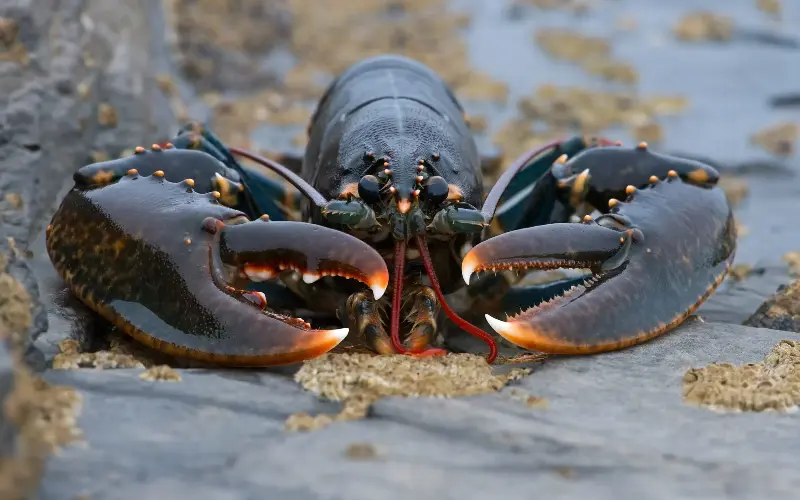
Restaurant owners are facing a summer lobster shortage as rising temperatures bring predatory octopuses to British waters.
Prices are up 20 per cent annually in some parts of the country, partly because of a depleted population, as predators migrate north into unusually warm seas.
The waters around parts of Britain’s south and east coasts were as much as 5C warmer than usual last week, according to the Met Office.
Jack Stein, the chef director at his father Rick Stein’s restaurants, said the number of lobsters caught off the Cornish coast had been falling since early spring.
He told The Telegraph: “The octopuses are now in Padstow. They’ve come all the way round from Land’s End and that means they are now migrating further north.
“Fishermen are landing plenty of octopus, but not a lot of crab or lobster at the minute and one fishmonger has warned us to prepare for a time when we may not be able to get any [lobster] in Cornwall.”
He said: “The prices are going absolutely through the roof, because the supply is just not there. Crab and lobster are up 20 per cent compared to this time last year.
“It could get to a point where we can’t afford to put it on the menu, nobody is going to spend £100 on a lobster, it’s just not going to happen.”
Mr Stein said that restaurateurs were adapting by putting more octopus on the menu and serving lobster from Wales or Scotland.
He added: “It’s not the first time this has happened and I am hoping that this is just a bit of a bloom and [the octopuses] will go away like they have in the past, but at the end of the day, you just never know.”
Restaurants and sellers would see the effects of the hot weather in five to eight years, the time it takes for a lobster larva to reach catching size, Dennis Gowland warned.
Mr Gowland, a marine biologist at the Northbay Innovations shellfish technology firm, said: “Female lobsters’ eggs mature more quickly depending on the temperature, so they might release larvae in May instead of July.
“Everything’s interdependent – if the larvae are out too early and there’s nothing for them to feed on, the chances of them surviving are much lower.”
Mr Gowland said that hatcheries, which nurse lobster larvae through their initial development before releasing them back into the sea to mature, would “fill the gaps”.
The animals would be forced to adapt to soaring summer temperatures, hatchery bosses said.
Ben Marshall, head of production at the National Lobster Hatchery, said: “They’re resilient – or, we hope they’re resilient. Lobsters can adapt, as they do hatch from North Africa to Scandinavia. The question is whether ours can adapt fast enough.”
Joe Redfern of Whitby Lobster Hatchery said heat was only one of several “increasing pressures” on the animals.
He said: “We’ve had big pollution events, and there’s a lot of pressure from fisheries, changes in algae, things that change the system.
“The heatwave could be the straw that broke the camel’s back in that sense – if we weren’t seeing all those pressures, then maybe the heatwave wouldn’t have the same impact.”
Mr Redfern said: “We’ve seen this really dramatic boom, a 400 per cent increase in lobsters landing into Whitby over the last 15, 20 years.
“But what we’ve seen in the past is these booms leading to a bust – that’s what we’ve seen for whaling, herring, tuna, whitefish.”
He added: “The main difficulty for us is increasing pressure from commercial fisheries. We’re not against that, but we want to continue sustainability into the future.”
The marine heatwave has been fuelled by record-breaking “heat dome” air temperatures in May and June, the Met Office said, with 35C forecast this week.
Warm weather gives the sea surface limited opportunity to cool, according to the national meteorologist.
The shortage is a further blow to the industry after Labour pledged to ban boiling live crabs and lobsters.
Laws introduced under the Tories in 2022 determined that decapods, which include crabs, lobsters and crayfish, and cephalopods, such as squid and octopuses, are sentient.
In an animal welfare strategy published last December, the Government said “live boiling is not an acceptable killing method” and pledged to publish guidance on approved practices.