



Of all the things you can do in midlife to live longer – eat better, sleep more, stress less – picking up a tennis racquet may be the most powerful. And the most enjoyable.
A 25-year Danish study found that tennis players lived an average of 9.7 years longer than people who didn’t exercise, nearly three times the gain seen in joggers, and more than six times the benefit associated with going to the gym.
And a study published in BMJ Medicine in January, drawing on 110,000 people over 30 years, found that playing tennis was associated with a 15 per cent lower risk of dying – the strongest results for a single form of exercise.
With this in mind, I decided it was time to pick up a racquet and hit the courts.
After spending years getting fit with gruelling high-intensity interval training, I wanted to make exercise fun again. As tennis is a game, surely it’s one of those sports where you don’t feel like you’re doing exercise. Perhaps I’d be running around the court smashing winners in no time, showing off my Roger Federer-like grace, while adding a few more years to the clock.
That was until I met my new playing partners in my group training sessions. This group consisted of women who were decades older than I am – in their late 60s and 70s – who were capable of hitting skidding balls with such vicious spin that they left me rooted to the spot. They were the living embodiment of tennis and longevity.
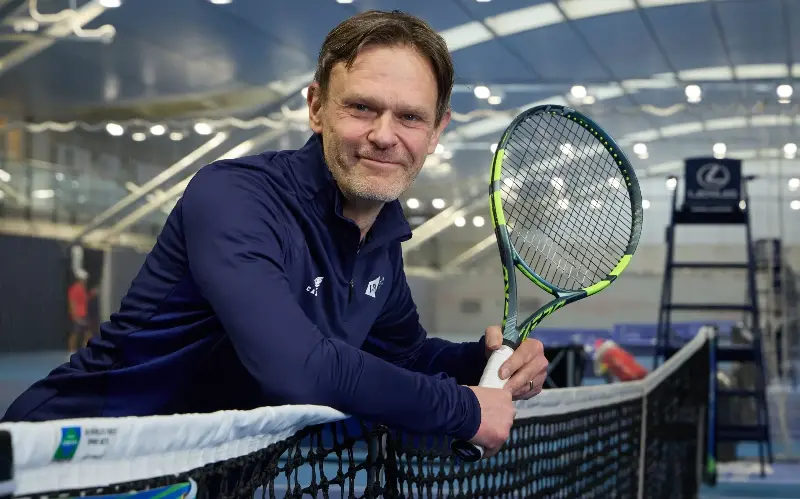
I had been put through my paces by Lee Neale, a 71-year-old Lawn Tennis Association coach and over-65s Welsh champion. It was like playing against a greying Rafael Nadal, impossible to return his powerful, well-aimed shots.
Neale plays with the mental agility and athleticism of a much younger man. As the younger man, at 53, I felt like I was already over the hill in comparison. He was clearly reaping the many health benefits from playing tennis, of which I was keen to learn.
This is how tennis benefits the body and brain.
It gives you a much better workout than the gym
“Tennis is one of the most complete forms of full-body conditioning available,” says Dr Mark Kovacs, an expert in sport science, who has worked with Grand Slam champions and Olympic medallists. “The movements are multiplanar [simultaneously forwards/backwards, side to side] and rotational – far more functional than the linear exercises most people do in a gym.”
The sport constantly gets you to twist, lunge sideways and change direction – the kind of co-ordinated, whole-body movement that keeps you mobile and steady on your feet as you age, he adds.
It boosts heart health
Dr Babette Pluim, the chief medical officer of the Royal Dutch Lawn Tennis Association, says that “tennis constantly alternates between explosive effort and recovery – much like modern high-intensity interval training,” which is what helps you get fit, fast.
“Although players are active for only around 20 per cent of match time, heart rates repeatedly surge very high during those bursts,” she says.
This trains the heart to return to its resting rate more quickly – otherwise known as heart rate recovery. This is one of the strongest predictors of cardiovascular health – people whose heart rate drops back quickly after exertion have a significantly lower risk of heart disease and death.
It improves balance and strengthens bones and joints
The explosive bursts of activity in tennis work the fast-twitch muscle fibres, responsible for quick, powerful movements such as sprinting and changing direction that steady exercise such as jogging doesn’t improve. These are the fibres you lose fastest as you age, and the ones you need most to stay balanced on your feet.
“The weight-bearing, multidirectional nature of tennis also stimulates bone growth,” says Dr Pluim. “Studies consistently show significantly greater bone mineral density in the dominant arm of tennis players, compared to their non-dominant arm – often 10-20 per cent higher.”
Every sprint, sudden stop and change of direction sends force through the legs, hips and spine, which triggers the bones to thicken and stay strong, she says.
Her research also found that a typical match involves more than 500 changes of direction. That constant lateral movement helps maintain the strength and stability of joints in a way that straight-line running doesn’t.
It could ward off dementia
The physical pay-offs are impressive. But they don’t fully explain why tennis adds so many more years to life expectancy than other vigorous sports. Something else is going on, and it is happening in the brain.
“Tennis is essentially high-speed decision training,” says Dr Kovacs. “On every shot, you’re processing visual information, anticipating your opponent, calculating trajectory and choosing among multiple tactical options.
“It stimulates processing speed, working memory and spatial awareness. And no two rallies are identical – the brain never gets to settle into autopilot.”
But it isn’t just the thinking that matters – it’s that you’re thinking and moving at the same time. Tracking the ball, executing the shot, then recovering your position at speed to prepare for the next one. That combination of cognitive and physical effort simultaneously is what researchers believe offers the strongest protection against dementia – far more than either exercise or mental stimulation alone.
A 2025 meta-analysis of 32 clinical trials found that motor-cognitive dual-task training – exercising the body and brain simultaneously – was the only intervention that significantly improved thinking skills and memory in people with early cognitive decline.
“As we age, the ability for the brain and body to work together at the same time often declines,” says Dr Shin-Yi Chiou, an associate professor of motor control at the University of Birmingham.
“Playing tennis is a great example of the type of activity that challenges both the body and the brain.”
It stops the brain from slowing down
The stop-start pattern of tennis appears to boost levels of a protein called BDNF, which encourages new brain cell growth and strengthens connections between existing ones.
Dr Claire Hanley, a senior lecturer in cognitive neuroscience and ageing at Swansea University, says tennis lights up a remarkable spread of brain regions. That activation strengthens neuroplasticity – the brain’s ability to rewire and adapt – which naturally declines with age.
“It builds grey matter in key brain regions and promotes myelination, the protective coating around nerve fibres that keeps signals fast,” says Dr Hanley. When that coating degrades, reaction times slow. Tennis helps prevent that.
The social side is great for longevity
Tennis is also intensely social and “you don’t need to be good at tennis to get the benefits”, says Dr Kovacs. “The cognitive engagement, the social connection, the physical demands – they’re all there whether you’re playing at Wimbledon or hacking around a park court on a Tuesday evening.”
I’ve become fitter as the sprints between shots work my lungs, and my hand-eye co-ordination has improved too. When I started, I whacked the ball out of the court. Now, I can time my swing to hit a fast incoming ball, with topspin, so no matter how hard I hit it, it still stays in the court. The sense of achievement when it all comes together can’t be underestimated.
I now spend time every week moving, thinking and trying to outwit people who are mostly better than I am. If the science is right, that habit alone could add more years to my life than any amount of time on a treadmill.