



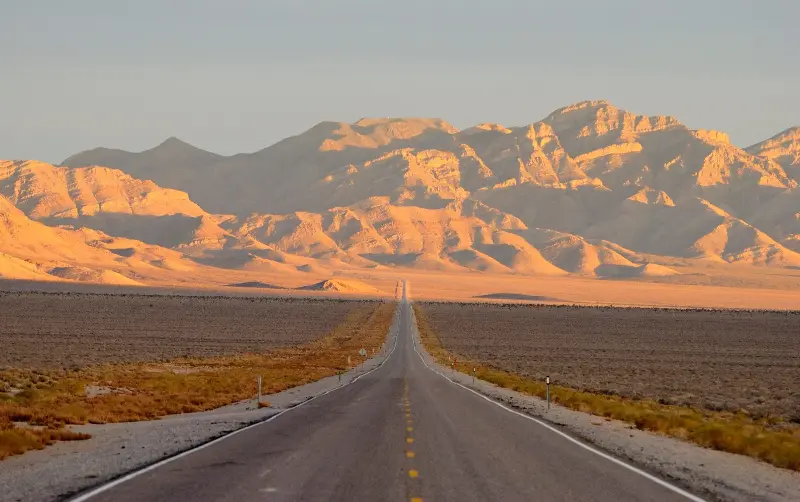
Nevada’s historic silver mining town of Tonopah, bleached by the sun and seemingly forgotten by time, has recently seen an uptick in visitors. According to local lore, they’re arriving not from neighbouring states or even other countries, but from another planet entirely.
“People see UFOs all the time out here, and it’s happening more often,” says Marlena Dufour, matter-of-factly. “Look straight up and you might see bright lights trying to get your attention. They can move incredibly fast and then – puff! – they disappear. They’re unlike anything a human could create.”
Dufour is a Tonopah local who works at the Central Nevada Museum, which charts the town’s glory days when it was called “Queen of the Silver Camps” in 1900, with mining relics and atmospheric tin shacks scattered across Nevada’s dusty high desert outside Las Vegas. In the fierce desert skies above this otherworldly landscape, says Dufour, unexplained craft appear often.
In search of my own close encounter, I’ve come to drive Nevada’s wonderfully weird Extraterrestrial Highway, a 98-mile stretch of road that has more reports of UFO sightings than any other route in America. It’s also one of the most desolate highways in the country, cutting through the remote reaches of south-central Nevada and tracing the edge of Area 51, the hush-hush National Security Site and highly classified US air force facility, which many believe to be a top-secret laboratory for captured alien spacecraft.
Since State Route 375 was officially renamed the Extraterrestrial Highway in 1996, travellers like me have come armed with telescopes and hope, scanning the skies for a glimpse of something otherworldly – not to be confused with the military jets that zigzag through the air from the test ranges nearby.
Most leave America’s Alien Country with stories rather than hard evidence, Dufour warns me. “Unfortunately, it’s hard to capture UFOs on phones and cameras. That’s why we don’t have many videos or photographs of them.”
Yet earlier that day, I’d encountered plenty of purported proof at a pit stop along the highway. Having set off from Las Vegas, I’d spent two hours driving through an apocalyptic-looking landscape punctuated by spiky Joshua trees, rocks carved with petroglyphs and Native American rock art, and the occasional ghost town surrendering to the elements.
I pulled into Rachel, a blink-and-you’ll-miss-it outpost of just 32 residents. Outside the Little A’Le’Inn motel and cosmic diner, a green Martian statue clutches a hand-carved sign reading “Earthlings welcome”. Inside I grabbed a stool at the counter, where saucer burgers slathered in “secret alien sauce” were flying out of the kitchen’s atomic hatch.
My bottomless cup of coffee was served by a real-life resident alien – a friendly Briton with spaceship tattoos inked across his hands – in a mug stamped with the warning: “Area 51: Restricted Area”. Around us, the walls are plastered with photographs that enthusiasts say show unidentified objects hovering over the desert.
The inn is about 10 miles from the fenced perimeter of Area 51, the military base the US government did not fully acknowledge the existence of until 2013. Even today, it’s not marked on maps. I followed the winding road toward the back gate, where coils of barbed wire crown the fences, security cameras swivel overhead, and warning signs forbid photography – despite the site’s popularity with YouTubers.
Area 51 was established in 1955, selected in part for its exceptional isolation: a vast desert basin encircled by mountain ranges that obscure visibility and limit access from surrounding routes. The dry lakebed at Groom Lake offered a naturally flat expanse suitable for testing classified aircraft during the Cold War, when experimental surveillance programmes were developed far from public eyes.
In this environment of enforced secrecy, speculation quickly took hold. By the late 20th century, as only partial details of its operations were declassified, Area 51 had already assumed a far larger role in the public imagination, becoming associated with alleged crash retrievals, reverse-engineering of unknown technology and unexplained aerial phenomena.
Its mythology was further cemented in popular culture by The X-Files, which helped frame it as the archetypal locus of government secrecy and extraterrestrial possibility. The tension between what is officially acknowledged and what remains undisclosed has ensured its status not simply as a military installation, but as one of the most persistent sites of modern American myth-making.
For those seeking to delve further, the fascinating National Atomic Testing Museum in Las Vegas hosts a permanent exhibition, Area 51: Myth or Reality, featuring “Russian Roswell” debris said to come from an alleged UFO crash site alongside documents and equipment linked to the development of radar-evading technology in the Nevada desert.
What happens behind the guarded gates remains cloaked in secrecy, but the mystery itself has become a kind of commodity. It has brought a constellation of offbeat, alien-themed businesses to the route, such as the Alien Research Center in Hiko, a domed iron bunker not too far from the back gate of Area 51 which serves as a supply store for UFO hunters, stargazers and conspiracy theorists. Another Hiko pit stop is the tongue-in-cheek E.T. Fresh Jerky, where a flying saucer appears to have crash-landed out front.
A word to the wise: stock up on plenty of food and water at these pit stops, and fill up the tank whenever the opportunity presents itself. Petrol stations on the Extraterrestrial Highway appear less frequently than little green men. Driving north-west for almost two hours, I saw a grand total of seven cars.
There’s something exhilarating about having nothing but open road up ahead, the rear-view mirror filled with hulking mountain ranges. Pop The Good, the Bad and the Ugly soundtrack on the stereo, and it feels like starring in a widescreen Western.
Tonopah, just beyond the northern reaches of the highway, was once one of the richest towns in the West. As well as the Central Nevada Museum, the town is home to the Tonopah Historic Mining Park – another outdoor museum where you can dig further into the area’s mining past – and the historic Mizpah Hotel. Built in 1907 during the heady boom years, when it once welcomed politicians and moustachioed prospectors seeking silver and gold, the 52-room hotel has been restored with bordello-chic interiors and an old-timey restaurant serving slabs of steak.
A more recent arrival is The World Famous Clown Motel. A neon Ronald McDonald sign flickers outside, and beside it lies Old Tonopah Cemetery, with crumbling headstones and weathered wooden crosses, like a scene from a Stephen King novel. Vijay Mehar, the motel’s owner, showed me around the eerie clown museum, home to 6,000 clown figurines whose glassy eyes seemed to follow me around the room. “America’s Scariest Motel”, as it proclaims itself, has become a magnet for thrill seekers who have seen the place on social media and “want to see scary things”, Mehar told me.
The 33 guest rooms embrace the clown theme to varying degrees of creepiness. My room is relatively restrained, decorated with bizarre paintings of Marilyn Monroe and Ronald Reagan in full jester regalia. Next door, however, is a genuinely terrifying Chucky-themed room with demonic décor, while there’s also a Clownvis Presley suite for fans of The King.
That night, I take a paranormal tour of the historic cemetery, led by the motel’s resident ghost-hunter. Clutching bleeping electromagnetic field meters said to detect ghosts, we explore the graves of miners who met their end in gunslinging shoot-outs or beneath the wheels of runaway steam trains, each tin plaque reading like the plot of a vintage pulp fiction novel.
We don’t see any ghosts, or UFOs. But what we do see is just as wonderful: above us, stars that shine so brightly it feels as though you could reach out and touch them – a dazzling reminder that Tonopah is also one of the country’s best stargazing spots. This is a road trip that truly expands the mind, as all good adventures should.
Back on the Extraterrestrial Highway the next day, on my return drive through the lunar landscape, Las Vegas suddenly springs up without warning. A chorus line of twinkling casino signs gives way to a replica of the Eiffel Tower. It occurs to me that in a state that’s built on surreal spectacle, Nevada’s Extraterrestrial Highway isn’t quite as strange as it sounds.
Essentials
Zoey was a guest of Brand USA. Fly directly to Las Vegas from Heathrow or Manchester with British Airways or Virgin Atlantic. Pick up a hire car with enough poke for a 450-mile round trip through the desert, and the most comprehensive car insurance you can get.
The World Famous Clown Motel has doubles from $90 (£67), room only. Mizpah Hotel has doubles from $120 (£89), room only.
For more information, Travel Nevada has a guide to travelling the Extraterrestrial Highway.