



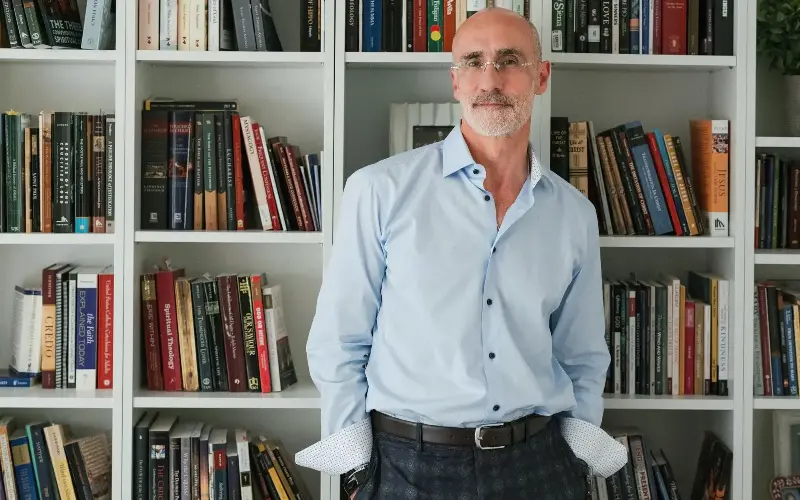
You might call Arthur C Brooks “the happiness professor”. He teaches courses on leadership, happiness, and nonprofit management at Harvard University in Cambridge, Massachusetts. He has written best-selling books on growing older with joy and purpose, and he has helped many high-achievers – he calls them “progress addicts” – who feel lost and despondent in retirement to find new significance and satisfaction. A new book, The Meaning of Your Life: Finding Purpose in an Age of Emptiness, is his latest work.
He’s also a columnist and an international keynote speaker who previously served as president of the American Enterprise Institute, a global conservative think tank. But as he’d say – lyrical, erudite, and witty, he’s a mesmerising talker – all that’s the “who”. It’s “fine at a cocktail party”, but it’s not his “why”.
Though his calling is helping others lead more fulfilled, loving lives, Arthur’s “why” is what will always give his existence meaning: his relationship with his wife, Ester; his three children; his Catholic faith. He describes the importance of aspiring to “moral beauty” and – what a rare thing – embodies it. Decades ago, he was struck by the words “He who saves a single soul saves a whole world” in a religious Jewish text. Ester’s response was, “Let’s adopt a child.” They did. “It’s one of the most meaningful things that’s ever happened to me,” he says.
Here, he explains how anyone can find greater life purpose and contentment.
Signs you’re struggling to find purpose
A meaning crisis can occur when you find yourself in a career or situation that feels random or insignificant. Often people who feel purposeless have no clue why they’re doing what they’re doing, says Arthur. “They’ll say: ‘I’m just going from thing to thing, I’m marking time. I’m in an airport lounge waiting for a flight that’s permanently delayed.’”
Avoiding discomfort, uncertainty and fear is another sign of existential crisis. For many, hiding behind tech feels safer. “People say that life feels weirdly fake, like a simulation of a real life – often because it is,” says Arthur. “Work is a Zoom simulation of human interaction. Social media is a simulation of a social life.” Blame smartphones. “The anti-boredom devices we’ve created have stolen our sense of meaning.”
Tech leads us to overuse the analytical left hemisphere of our brains, fostering the mentality that any problem must have an engineered solution. Arthur says we’re neglecting the right hemisphere, “dedicated to the mysteries of life, to living as opposed to solving, to understanding as opposed to conquering – and that’s an intuition that gives life to life”.
Arthur notes that Henry Brooks, his ancestor who came to the US in 1630, probably lived “moment to moment” an unexciting life. But overall, his life had meaning, so it was “exquisitely interesting”. The difference nowadays, he adds, is “moment to moment, there’s not a single second of boredom, but at the end of the week, and month and year, there’s nothing but grinding boredom”.
Our hyper-engineered technological solutions lead to a “coarsening of human experience”, he says. Imagine. “You wanted a cat, because you like cats, and I gave you a mechanical cat. Your cat is a pain, your cat ruins the furniture, and your cat sometimes withholds its love from you, and your cat actually doesn’t love you – it just uses you, and you know that – but the mechanical cat will do all the things that apparently you want, and will leave you completely cold.”
Finding meaning is down to you
Arthur, 61, says: “My first big struggle with finding purpose was in my late 20s – this is going to sound absurd – when I was playing in the Barcelona city orchestra and realised I wasn’t going to be the world’s greatest French horn player. I didn’t know what to do. I didn’t know why I was on the Earth.”
Following his French horn crisis, he found his purpose in two ways. “One was by falling in love and getting married. The other was reconnecting with my faith,” he says. “Love is the answer.” He was 24 when he and Ester locked eyes across a concert hall in France. She was Catalan and spoke no English. Arthur spoke no Catalan. They lived in different countries. Yet two years later, he proposed. They recognised and acted on their “mystical” connection. To find purpose, he says, you need to “recreate the conditions that once were ordinary so the meaning of life can find you”.
That search is your responsibility, so thinking and acting independently, exercising curiosity and determination, is key. To clarify your life’s coherence, purpose, and significance, which make up its meaning, Arthur suggests asking yourself: Why do things happen the way they do in my life? Why am I moving in this direction? Also, in a nudge to attend to your relationships: Who’d care if I didn’t exist?
Arthur notes that Koko, the gorilla who famously learned to sign over a thousand words, never asked a question. “A lot of people go through life like that, and don’t understand why their life feels empty,” he says, adding: “Coming to our house is very uncomfortable for entertaining, because most likely within the first 15 minutes, one of us will ask you, ‘Anna, what are you most afraid of?’ Our philosophy is ‘go deep or go home’.”
Make your leisure (and retirement) meaningful
We live in a selfish age. But self-focus doesn’t bring happiness. “It’s just incredibly boring, because it’s this one-way valve: me, me, me,” says Arthur. With this in mind, he advocates “meaningful leisure”, which might entail using your expertise to help others and improve intimate relationships. “It does not mean sitting on the beach doing nothing. What that is, is a way to recharge your batteries so you can go do more work.”
He says, “Philosophical and spiritual work, learning, and relationship deepening – those are the three things to focus on when you’re not getting paid, or rewarded with fame, power, or wealth.” When he wrote a book in 2022 on finding success, happiness, and purpose in midlife and beyond, he says, “a lot of CEOs and athletes and actors reached out”. Close to retirement, they feared feeling insignificant.
“I helped them cultivate great meaning and depth and value outside of what the world had rewarded them for, to find intrinsic satisfaction, reward, service, where it was all extrinsic previously.” He moved them into teaching and coaching roles. He encouraged them to spend more time with their spouse, to attend church, “focusing on these things with the same seriousness that they’d only ever focused on their 7am-7pm jobs”. He helped them improve at “the business of life”.
But what if you’re already retired and feeling lost? Arthur experienced something of this when, at 55, he left the American Enterprise Institute, “with no idea what I was going to do with the rest of my life.” His solution, as a devout Catholic, was to go on “a long walk”. He walked the Camino de Santiago pilgrimage with Ester. “I was putting myself in a position where my meaning would find me,” he says.
You don’t have to be religious to create similar conditions. “A pilgrimage can be done in a philosophical or secular spirit,” says Arthur. “It requires that you take a long, physical journey while contemplating something that’s troubling you.” He adds that research suggests “the mundane physicality of the experience actually opens one’s right hemisphere – the side of the brain responsible for love, mystery and meaning – in ways you can’t do in, say, your living room.” In short, he advises, “Walk and be found.”
Don’t try to eliminate suffering
In a new spin on gratitude journals, Arthur keeps a journal tracking failure and disappointment. “They happen on this incredibly regular rhythm,” he says. “And every time we’re caught out. ‘What! How did this happen?’ It’s always happening. And so when you put some cognitive energy into understanding that this is part of life itself, it becomes less surprising.” A month later, he’ll write about what he learned. “Sometimes it might be that the pain didn’t last as long as I thought it was going to.”
He says: “One of the most important ways to find meaning is to suffer, and when we live in an algorithmic world of distraction and solution, we try to eliminate pain. People will use drugs and alcohol, they will use internet activity, they will use workaholism as a way to distract themselves.” In turn, he says, older generations were “much better at realising that suffering is not something to eliminate but instead something to manage, accept to some degree, and take meaning from”. He adds: “I send people to the gym all the time, to lean into physical pain and thus understand pain in general. That’s one of the best ways you can manage your negative affect.”
He’s not tritely suggesting that in terrible suffering one should look on the bright side. “You acknowledge that pain is inevitable,” he says. “And that you have two choices. You can have pain without learning. Or you can have pain with learning.” Often, when people look back “at the points in their life when they became more resilient, when they understood their own lives more, it was in the moments of pain”.
Don’t try to earn love through achievement
“I deal with a lot of strivers – people who are high-achievers,” says Arthur. “Those people, according to the best research, tend to be more disappointed with their lives by age 80.” The clue is in how they’re raised. “These are people who get attention and affection from adults when they do things. And their little synaptically plastic brains conclude that love is something that’s earned through extraordinary achievements and hard work and getting good notes in school and making the soccer team and on and on, and then if you learn that, you’ll spend the rest of your life trying to earn love.”
The irony? “Love can’t be earned. That’s a misunderstanding of love. You can’t have a happy marriage if you have to earn your spouse’s love.” Arthur says a striver might struggle with their relationships while working 16-hour days in search of progress, for instance. He says he himself has “idiotically” tried to earn his wife’s love through accomplishments, which he considers a futile exercise. “Your spouse will never love what you achieve but rather who you are,” he says. “Love is about being, not doing.”
Be true to your values
Arthur scorns performative righteousness. “In a world of virtue signalling, you can put on Twitter what a good person you are, because you are appropriately angry at somebody – no, no, sorry,” he says. “One, figure out what you believe, and two, live up to it.” Although when Ester suggested adopting a child (they had two young sons), his response was, “That sounds expensive!” He laughs. “But she was talking about radical love. Let’s put our money where our mouth is. Let’s put everything where our mouth is. We believe we can change the whole world in one person, let’s act in love. And so we did.”
Every time he sees his now adult daughter, adopted from a Chinese orphanage, “it’s like the first day”, he says. “Every time, it’s like when they put her in my arms. She grabbed my shirt, and she looked up at me, and she wouldn’t let them take her away from me after one minute – because we were meant to be together.”
Arthur says: “Ultimately, when you give away your heart in love, you’re the one that actually wins.” And it’s why, to those feeling somewhat lost – especially in retirement – he advises: “Treat your love relationships, faith, or routes to beauty – via art, music, nature, or moral beauty – with the same utter seriousness as you took your career.”