



Every few years my other half and I treat ourselves to a long weekend in Capri. It’s our happy place, if not so blissful for our credit cards. We bed down at our favourite hotel, Villa Brunella, and, in the evenings, when the day trippers have gone back to the mainland, we wander the narrow lanes, have an Aperol spritz in the main piazza, try out different restaurants and find new flavours of gelato at Buonocore – literally the only place in the world where I’m prepared to queue.
Things feel increasingly busy, though, especially in peak season. It might just be my Instagram feed, but in recent years Capri and the Amalfi Coast seem to be on the radar of every travel influencer out there. They’re just so perky: hashtag blessed, hashtag soulful journey, hashtag finding myself. Are we really at a stage where you need to bring a ring light to film a video of your dinner on the balcony of Le Sirenuse?
So if, like me, you want a break from €50 sun loungers at Lido L’Incanto in Positano and a change of scenery in general, I would suggest venturing north to the country’s smallest province, Valle d’Aosta.
Italophiles might, at this point, be spluttering into their marmalade that you can’t compare the two – it’s like saying Cornwall is busy, so go hiking in Northumberland. And they have a point, but if you are willing to try something different, you may find yourself, as I did, pleasantly surprised.
Aosta is tucked away in the far northwest of Italy, an easy 50-minute drive from Turin. It’s north of slow-food capital Piedmont and positioned around the back of Mont Blanc and other soaring Alpine peaks, with Switzerland buffering the north. It’s been a fortified passageway from west to east since Roman times; indeed, remains from that period scatter the town of Aosta itself, which is a good base from which to start exploring.
I stayed in the family-run Milleluci Hotel, which has a spa, a pool and a simple but outstanding buffet breakfast, about a 15-minute walk downhill from the centre. In the centre, the Arch of Augustus and Porta Praetoria still stand after two millennia – as do most parts of the ancient theatre and subterranean porticoes.
There are a few pedestrian shopping streets, selling everything from food to wooden toys, that lead to the rather grand main piazza where, as in many Italian cities, for a few euros you can grab an espresso and sit and indulge in a leisurely bout of people watching.
A 10-minute drive away is the small, family-run Grosjean vineyard, clinging to the terraces of the steep hills that rise above town. They’ve been producing wine here since the 1960s, and tastings are charmingly informal.
When it comes to food, you’ll find the region straightforward and unfussy. Fontina cheese finds its way into many menus, as does polenta. Carbonade (beef cooked slowly in red wine) turns up often, as do soups thick with barley or beans – all of it is hearty food that’s great for hiking or skiing. If you’re one of those people who love a good poke around a foreign supermarket, you’re likely to strike gold at the Gros Cidac Hypermarket: I came away with various local schnapps, biscuits, hot chocolate, pasta and even beautifully packaged liver salts.
From Aosta, you can drive west to Courmayeur. Although renowned as a winter ski resort, it stays busy with walkers throughout the summer. I took the Skyway Monte Bianco from just outside town, a rotating gondola that climbs to over 3,400 metres. At the top, I stepped out into thin, dry air and a snowy panoramic view that stretched across to France and Switzerland.
On the way back, I got chatting to Stuart Macdonald, a British alpine guide. “For a summer hike, start at Col San Carlo and take the trip to Lago d’Arpy and beyond up to Lago de Pietra Rossa – it’s stunning,” he told me. “Early autumn trips there when the vegetation is changing colour are particularly memorable. In eight or nine kilometres you gain about 600 metres of height, and there are some steep sections with chains and ladders, so it’s not great for those without a head for heights.”
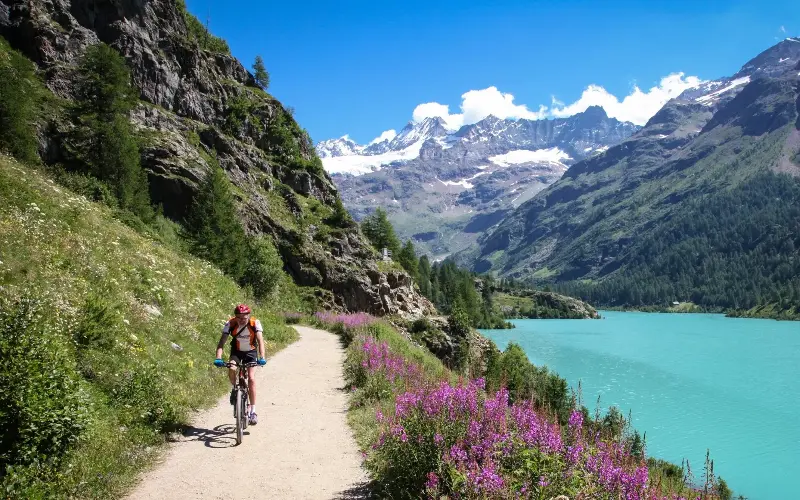
I wrote it down for next time and walked instead up to Rifugio Walter Bonatti in Val Ferret, which had been another recommendation. The path climbs steadily but not aggressively through larch forests and along alpine meadows, with views back to glaciers hanging high on the opposite side of the valley.
After just over an hour, the hut, sitting on a small rise with tables outside, came into view. I had a decently priced lunch – polenta with cheese and sausage, salad, and a glass of red – then sat and watched clouds drift over the peaks before ambling back down.
My last stop was Bard, halfway down the valley. The village sits at the narrowest point of the gorge, watched over by an enormous fortress built in the 19th century to control the route to France. It’s now a museum, but you can still sense why it was built: travelling from France towards Turin, everything funnels through this gap. Below, the village of Bard itself has a handful of cobbled lanes and squares with cafés and galleries, which, during my visit, were practically deserted.
I stayed at Ad Gallias, a restored stone building in the centre of the old village. I hadn’t been expecting much, but the hospitality blew me away – a genuinely warm welcome, a cosy bedroom and a truly outstanding dinner. The rooms had vaulted ceilings and thick walls that kept the heat out, and over the road, down some steps, was a small spa.
Bard made a calm end to the week, and while Aosta isn’t a like-for-like substitute for the Amalfi Coast, it does offer an insight into a different side of Italy altogether – quieter (outside the summer holiday peak) and slower. You come here for mountain air, solid food and a sense that life hasn’t been arranged for your benefit; you’re just a guest invited to peek in from the outside. Yes, I’ll be back to Capri for sure, but outside high season and only after I’ve checked out other lesser-known Italian regions on my must-try list.
Essentials
Wexas Travel offers a 10-day self-drive “Best of the Aosta Valley itinerary” from £1,260pp (two sharing), including flights to Turin, car hire, B&B accommodation, a private guided half-day excursion of Turin, and ticket to Bard Fortress.
For further information, visit: aosta-valley.co.uk