



For most proprietors, an establishment such as a restaurant or pub with rooms is a place of food, drink and comfort. For the owner of the Norman Knight, it serves as a depositary of vexing portrait photography. It’s not that I can’t appreciate vast prints by Norman Seeff of Steve Martin in various comedy poses, or a huge black-and-white set of Cher portraits, a close-up of Willie Nelson, or a huge photo montage of Tina Turner. It’s more that there is no escape from them, and they jar horribly with the otherwise stylish decor of this plain brick building – a former bakery – in Warwickshire.
The Norman Knight is in the village of Whichford, a place that trades on its Cotswolds locality but doesn’t quite have the cosy charm of other quaint Gloucestershire and Oxfordshire hamlets – nor the oozing, syrupy details that inspired Jilly Cooper’s fictional Rutshire. Whichford boasts a village green, for example, which is more a vast field – a giant mowing headache – than a pretty patch of grass flanked by duck pond, thatched cottages and inviting inn. So it’s a shame that, upon entering the Norman Knight, one’s appreciation of its chic bare walls, stone floor, stunning dark-wooden bar, deep leather chairs, wallpaper and candles is rudely interrupted by the thought: “What the f--k are those photographs?”
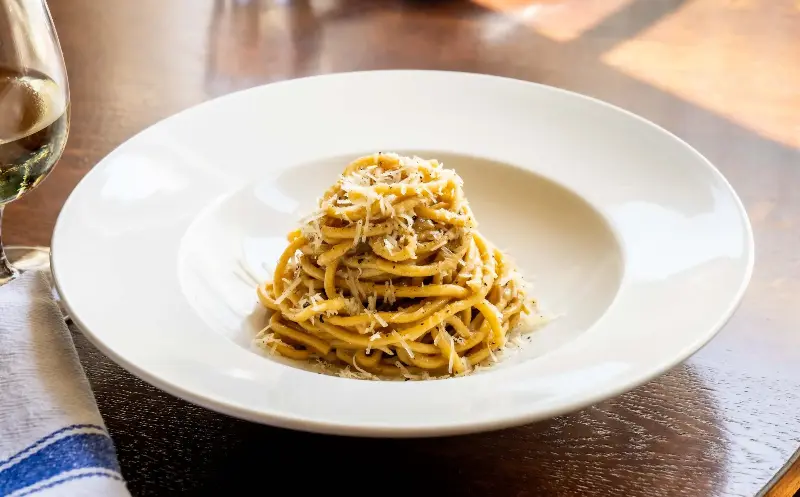
The cheerful and confident service calms us, however, as does the wine list. Any card with a bottle of aligoté (the third dominant Burgundy grape after chardonnay and pinot noir) deserves respect. The food menu, meanwhile, is a tidy offering of British dishes with some European influences. The finest dish of which I’ll get straight to, because it still excites me. I didn’t know about bigoli pasta and, I was told, its appearance here is thanks to a Venetian chef in the kitchen. He makes it himself – a stringy pasta, a little thicker than spaghetti, but with a glorious texture somewhere between softened rusks and cake. Some, I learn, call it wholemeal spaghetti, which helps to explain it but doesn’t do justice to bigoli’s porous texture, nutty flavour and bite. The “house bagoli” was cacio e pepe, starring that humble sauce of cracked pepper, pecorino cheese and pasta water. It was so good I almost forgave the wall art, which was getting more and more on my nerves as dinner progressed.
As well as the pasta, the skilled kitchen produces fine little sourdough loaves and sweet, crumbly soda bread. I started with an excellent little tart of goat’s cheese and asparagus, which reminded me of the greatness of a miniature tart and how sadly rare they are on menus. I fared better than Emily with her soft-shell crab tempura. The deep-fried clump of crab in an ugly criss-crossing of Marie rose sauce felt as out of place as those horrendous photos.
While Emily enjoyed her main course of the bigoli, I followed with “pulled rotisserie chicken, green beans, feta, dukka”. I was drawn to the word “rotisserie”, picturing a succulent charred bird, slowly turned and dripping with fat and flavour. Which made the plate that arrived a disappointment. My fault, perhaps, for overlooking the word “pulled” – shreds of meat were duly delivered, but it felt more like a safe (if delicious) ladies’ lunch rather than the man-food explosion I had mistakenly expected. There was a pud of decent profiteroles with a nice, sugary dulce de leche spiked with rum – but surely half the point of profiteroles is the hot chocolate sauce?
Having said all that, the Norman Knight is a great addition to this part of the world. Its pasta is a real display of excellence. It has lovely rooms and does a very fine breakfast. But here’s hoping its wretched photo collection enjoys, shall we say, a short residency.