



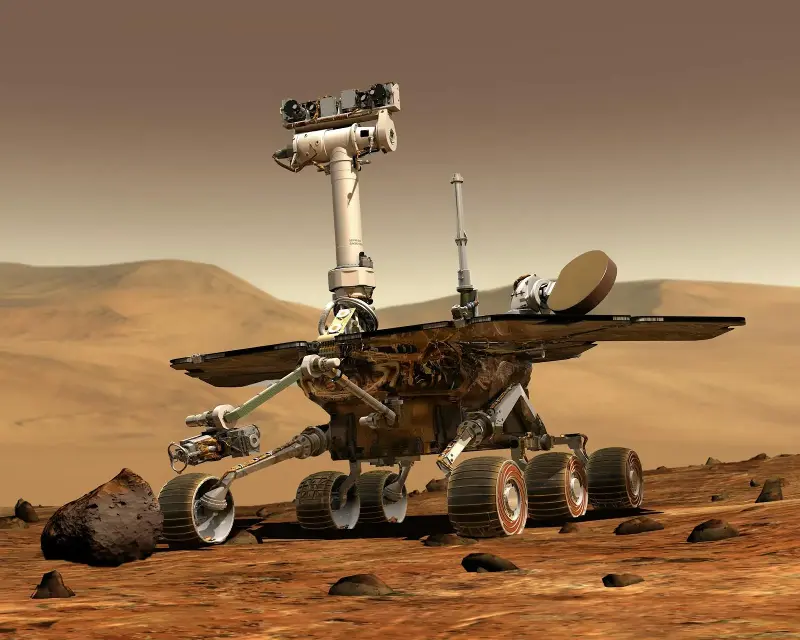
NASA’s Curiosity rover drilled a Martian rock sample in October 2020. The chemistry took years to resolve.
In results announced by NASA’s Jet Propulsion Laboratory on 21 April 2026, scientists reported that the sample contains the most diverse set of organic molecules yet identified on Mars. The work, published in Nature Communications by Amy J. Williams and colleagues, describes more than 20 organic molecules detected in a clay-bearing sandstone from Gale crater, including seven molecules confirmed for the first time on the Martian surface.
The finding is not evidence of life. NASA says scientists cannot determine whether the molecules formed through biological or geological processes, or arrived from outside Mars through meteorites or interplanetary dust. Its significance is narrower and still substantial: complex organic chemistry can be preserved in ancient Martian rock after billions of years at the surface.
What Curiosity actually found
The sample is known as Mary Anning 3, named after the English fossil collector and palaeontologist. Curiosity collected it from a clay-rich region on Mount Sharp, inside Gale crater, where lakes and streams existed billions of years ago. NASA’s JPL release says the wider Mary Anning area formed in an ancient environment that surged and dried multiple times, leaving minerals that are especially good at preserving organic compounds.
In the Nature Communications paper, the authors report in situ detection of more than 20 organic molecules from the roughly 3.5-billion-year-old Knockfarrill Hill member of the Glen Torridon region. Seven of the detected molecules were confirmed in the SAM data from the TMAH experiment: trimethylbenzene, tetramethylbenzene, methyl benzoate, dihydronaphthalene, naphthalene, benzothiophene and methylnaphthalene.
Those names are technical, but the broader point is simple. Curiosity was not detecting one isolated organic hint. It was detecting a mixed set of aromatic and sulphur-bearing molecules, plus signs of additional compounds that could not all be identified with the same confidence.
Why the result took years
Curiosity does not carry a full Earth laboratory. It carries a carefully miniaturised chemistry suite called Sample Analysis at Mars, or SAM, inside the rover’s body. Powdered rock from the drill is delivered to SAM, where ovens, gas handling systems, a gas chromatograph and a mass spectrometer can heat, separate and measure compounds released from the sample.
The Mary Anning 3 work used a special form of wet chemistry. SAM exposed the sample to tetramethylammonium hydroxide, usually shortened to TMAH. The reagent helps break apart larger or bound organic material into smaller fragments that can be detected by the instrument.
This matters because Martian organics are hard to read. Radiation, oxidants, minerals, heat and instrument background effects can all complicate interpretation. The Nature Communications paper spends considerable space on controls, contaminant checks, retention-time comparisons and laboratory work with SAM-like equipment on Earth. The chemistry came into focus slowly because the team had to show that the signals were not just artefacts of the instrument or the reagent.
The rover did the experiment on Mars. The interpretation took place across years of laboratory comparison and peer review.
The molecules are not a biosignature
Organic molecules contain carbon. In planetary science, that does not make them biological.
Some organic molecules are made by living systems on Earth. Others are produced without life, including in meteorites, interplanetary dust, hydrothermal settings and atmospheric or surface chemistry. The JPL release states plainly that either biological or geological processes could have made the molecules in Mary Anning 3.
That uncertainty is not a weakness in the result. It is the result’s boundary. Curiosity has shown that ancient Martian bedrock can preserve a wider range of organic chemistry than previously confirmed. It has not shown what made that chemistry.
One reason the finding still matters is that several detected structures are relevant to prebiotic chemistry. NASA noted, for example, that one newly identified nitrogen-bearing ring structure belongs to a class of molecules considered precursors to more complex nitrogen-bearing chemistry. Benzothiophene, a carbon- and sulphur-bearing molecule, is also known from meteorites.
Those connections do not turn the sample into a life claim. They place it in a broader chemical setting: early Mars had water, clay minerals, carbon-bearing compounds and environments capable of preserving them.
Why clay helped
The preservation context may be as important as the molecule list.
Clay minerals can trap and protect organic material. The Glen Torridon region has been of interest to Curiosity because it records water-altered, clay-bearing sediments on the lower slopes of Mount Sharp. In the Nature Communications paper, the authors describe the sampled rocks as part of ancient lacustrine and fluvial environments, meaning lake and stream settings.
That is the connection to habitability. A habitable environment is not only a place where liquid water once existed. It is a place where chemistry, energy, minerals and time may have interacted in ways that could support or preserve traces of prebiotic or biological processes.
Curiosity has been building that context since it landed in Gale crater in 2012. It has found evidence of ancient lakes, streams, clay minerals, sulphates, carbon-bearing molecules and changing wet-dry conditions. The Mary Anning 3 result adds a richer organic inventory to that record.
What comes next
The finding also has a practical mission-design consequence. NASA says SAM recently used its second and final TMAH cup while exploring boxwork ridges formed by ancient groundwater. Those results are still being analysed for a future peer-reviewed paper.
The same chemistry approach will carry forward. JPL says NASA Goddard has provided components for the Mars Organic Molecular Analyzer on ESA’s Rosalind Franklin rover and for the Dragonfly Mass Spectrometer, which will fly on NASA’s Dragonfly mission to Titan. Both are designed to use wet chemistry with TMAH.
That continuity is the quiet engineering story underneath the finding. Curiosity’s experiment was not only a Mars result. It was a rehearsal for how future missions may handle fragile organics on worlds where life is a question rather than an assumption.
The Mary Anning 3 sample does not answer that question. It makes the next version of the question more precise.
The post NASA’s Curiosity rover has identified the most diverse set of organic molecules yet found on Mars, including seven never before detected there, from a sample drilled in 2020 and studied for years before the chemistry finally came into focus appeared first on Space Daily.