



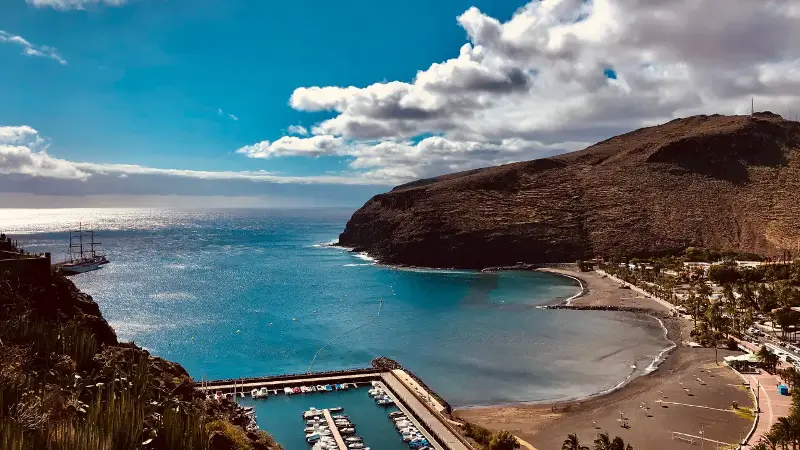
The island is called La Gomera. It sits in the Atlantic Ocean approximately 300 kilometres off the west coast of Morocco, in the western half of the Canary Islands archipelago. It is small, roughly 380 square kilometres in area, and dominated by an extinct volcanic dome that rises steeply from the sea. The interior of the island is cut by deep ravines called barrancos, some of them hundreds of metres deep, that radiate outward from the central peak toward the coast. For most of the human history of La Gomera, moving between two points on opposite sides of a barranco required a walk of several hours down one side and back up the other, even when the two points were only a short line-of-sight distance apart.
The language that developed in response to that geography is called Silbo Gomero, or simply el silbo. It is not a dialect, and it is not a code. It is a whistled register of Castilian Spanish, in which every syllable of ordinary spoken Spanish is transposed into a whistled tone of specific pitch, duration, and articulation, and in which fluent speakers can carry conversations of arbitrary complexity across distances that ordinary speech cannot reach.
The maximum documented range of a Silbo whistle is approximately ten kilometres, or roughly six miles. Under favourable acoustic conditions, a whistled sentence can travel across a full barranco, up the opposite ridge, and remain intelligible to a listener on the other side. The listener can whistle a reply that follows the same path in reverse.
How it works
The phonology of Silbo is substantially simpler than the phonology of the Spanish it replaces. Where standard Spanish has five vowels, Silbo has two, distinguished by pitch. Where standard Spanish has approximately twenty consonants, Silbo has four, distinguished by pitch and by whether the whistle is interrupted or continuous. The full inventory of the language, considered as a set of distinct sounds, is one of the smallest of any documented human speech system.
The simplification is possible because Silbo is not a self-contained language. It relies on the listener’s knowledge of Spanish to reconstruct the intended meaning from the reduced acoustic signal, in much the same way that a listener can reconstruct the intended meaning of a badly-degraded phone call from partial information. The whistler produces a stream of pitches and articulations that maps approximately onto the syllables of the underlying Spanish sentence. The listener, if they know Spanish and know Silbo, hears a sentence.
The production technique is specific and difficult to master. A silbador puts one or two fingers into the mouth to modify the shape of the oral cavity and produce a stable, high-frequency whistle. The other hand is often cupped around the mouth to direct the sound in a chosen direction, in the manner of a small acoustic megaphone. Pitch is controlled by lip and tongue position. Consonant articulations are controlled by rapid changes in tongue placement that briefly interrupt or modulate the whistle. Fluent silbadores can produce full sentences at speeds comparable to ordinary conversational speech.
The near extinction
Silbo Gomero had been in continuous use on La Gomera for centuries, and possibly for substantially longer than that. Its historical origins are not documented in the surviving Canary Islands records, but comparable whistled languages have existed in other mountainous regions of the world including Turkey, Mexico, and the Amazon basin, and the general phenomenon of whistled speech appears to be a recurring human response to the specific communication problem posed by rugged terrain.
By the second half of the twentieth century, however, the traditional context for Silbo had substantially collapsed. Modern roads made walking between barrancos less necessary. Telephones and mobile phones made long-distance voice communication available without any specialised acoustic technique. Younger islanders no longer needed to learn Silbo to conduct ordinary business, and the shepherds and mountain folk who had been the traditional carriers of the language were declining in number.
By the 1980s, most fluent silbadores on La Gomera were elderly, and the tradition of teaching Silbo across generations had substantially broken down. Linguists surveying the language predicted that it would be effectively extinct within a generation, in the same pattern of decline that has been documented for hundreds of minority language communities across the world during the same period.
The policy intervention
The Government of the Canary Islands, working with the Cabildo de La Gomera, took the substantially unusual step in 1999 of making Silbo Gomero a mandatory subject in every elementary school on the island. Children between the ages of six and fifteen were required to receive instruction in the language for approximately thirty minutes per week, delivered by fluent silbadores who had been recruited and trained as teachers under a formal government programme.
The policy has, on the available assessments, worked. Silbo Gomero is now understood by nearly all inhabitants of La Gomera and actively practised by a substantial fraction of the population, particularly among the elderly and the young. The generation of children who were taught Silbo from the beginning of the mandatory programme in 1999 are now adults, and many of them retain functional command of the language.
In 2009, UNESCO added Silbo Gomero to its Representative List of the Intangible Cultural Heritage of Humanity, citing the language as the only whistled language in the world that is fully developed and practised by a large community. The UNESCO listing formalised the international recognition that the language, which had been within a generation of disappearing, had been preserved through direct educational policy.
The brain science
In January 2005, a team led by Manuel Carreiras at the University of La Laguna published a paper in Nature reporting the results of functional magnetic resonance imaging studies of fluent Silbo speakers listening to whistled and spoken Spanish. The finding was substantially unexpected.
Fluent Silbo speakers, on the fMRI data, processed the whistles in the same left-hemisphere brain regions that they used to process spoken Spanish, including the left superior temporal gyrus and the classic language areas associated with the work of Broca and Wernicke. Non-speakers of Silbo, listening to the same whistles, processed them in different brain regions typically associated with music or non-linguistic environmental sound.
The interpretation was that Silbo Gomero is not, from the perspective of the human brain, a code or a musical system that its users translate into language. It is, for its fluent speakers, real language, processed by the same neural machinery that processes ordinary spoken words. The medium in which the language is delivered, in this specific case whistles rather than voiced speech, appears to be substantially less important to the brain than the fact that the signal is linguistically meaningful to the listener.
Subsequent studies, including work by researchers at Ruhr University Bochum in 2020, have added complications to the specific left-hemisphere-only interpretation, finding that Silbo processing involves bilateral brain activation to a greater degree than typical spoken language processing. The specific neurological details remain under investigation. The broader finding, that fluent whistled speech is processed by the human brain as language rather than as sound, has been repeatedly confirmed.
What it means
Silbo Gomero is the only fully developed whistled language currently practised by a large community anywhere in the world. Whistled registers exist in other cultures, but most of them have declined to marginal use or specific ceremonial contexts, and the traditional pattern of intergenerational transmission has broken down. The La Gomera case is the specific example of what happens when a linguistic tradition on the edge of extinction is preserved by explicit policy rather than allowed to disappear.
The Carreiras finding is a specific case of the broader observation that the language regions of the human brain are substantially more flexible than the twentieth-century neurological consensus assumed. The same regions that process spoken words in one context can, with sufficient exposure and training, process whistles in another, sign gestures in a third, and Braille tactile input in a fourth. What matters, on the available evidence, is not the physical medium but the linguistic content.
The children currently learning Silbo in the elementary schools of La Gomera are, at any given moment, one of the smaller populations of new speakers of any language on Earth. There are more children being raised in most single-family households of most major world languages than there are children being taught Silbo Gomero in any given school year.
The whistles still travel across the barrancos.
The shepherds who invented them are mostly gone.
The children who inherited the language are still learning to make them.
The post There is a language on a small Spanish island in the Canary archipelago that is made entirely of whistles, can carry a full sentence across six miles of mountain ravine, and is still taught to every child in school appeared first on Space Daily.