



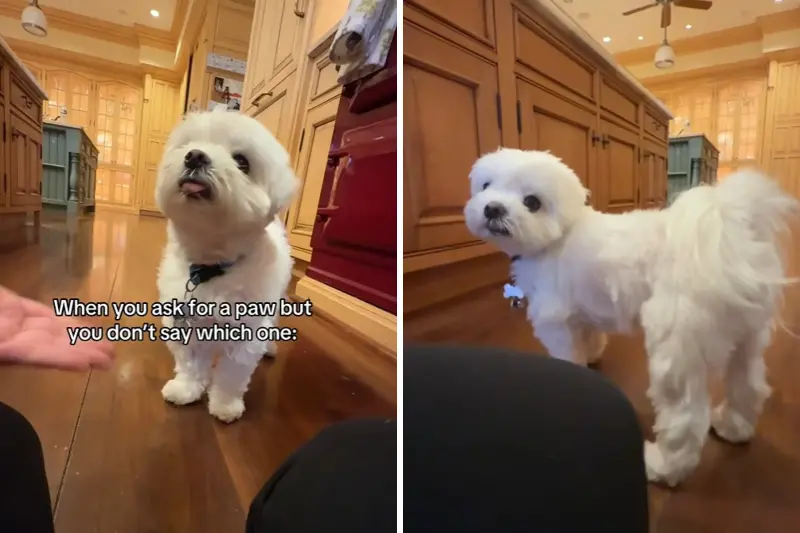
A tiny Maltese named Kenny has become a TikTok star after offering a very unexpected response to the classic “paw” command.
The 6‑year‑old dog didn’t lift a front paw as most pets do—instead, he confidently raised a hind leg, leaving viewers in stitches.
The clip, posted by his owner Amanda, 28, has now racked up more than 11 million views, with on‑screen text joking: “When you ask for a paw but don’t say which one.” That caption alone has drawn 1.9 million views.
Speaking to Newsweek, Amanda, who lives in Santa Monica, California, said: “Technically he did give me his paw.”
While Kenny knows the traditional version of the trick, he’s always had a flair for improvisation.
“When I first tried to teach him to give his paw he gave me the back one first,” she explained. “He learned how to respond with his front one soon after and now usually does that, but will throw in a back paw here and there. I love it.”
The video, captioned “a paw’s a paw,” has delighted thousands of commenters. One viewer joked, “I didn’t realize this was an option,” earning nearly 400,000 likes. Another wrote: “Never let them know your next move, Kenneth.” A third declared, “This is Kenny’s party trick,” while a fourth insisted he “deserves extra treats for that.”
Why Trick Training Matters
A survey by VetStreet, a web‑based platform for veterinary practices, found that 23.4 percent of dog owners say their pets know more than seven commands, while only 5.5 percent reported that their dogs don’t know any at all.
According to the American Kennel Club, trick training offers benefits far beyond entertainment. It’s enjoyable for both dogs and owners, strengthens communication, and reinforces positive learning habits. Tricks can be playful behaviors like spinning or “saying prayers,” physically engaging skills such as weaving between poles, or even practical tasks like placing paws on a stool to help with grooming or therapy visits.
Effective trick training relies on shaping, reinforcement, and teamwork rather than force. The AKC notes that owners often love showing off tricks—far more than everyday skills like loose‑leash walking—even though both types of training matter.
Tricks can also make shelter dogs more appealing to adopters, who may see a trick‑savvy dog as intelligent and well‑adjusted. And for children or teens interested in dog training, tricks offer an accessible, confidence‑boosting entry point.
Beyond the fun, trick training provides both mental and physical stimulation. After a session of exercise and learning, even high‑energy dogs are more likely to settle down and relax—rather than look for mischief.