



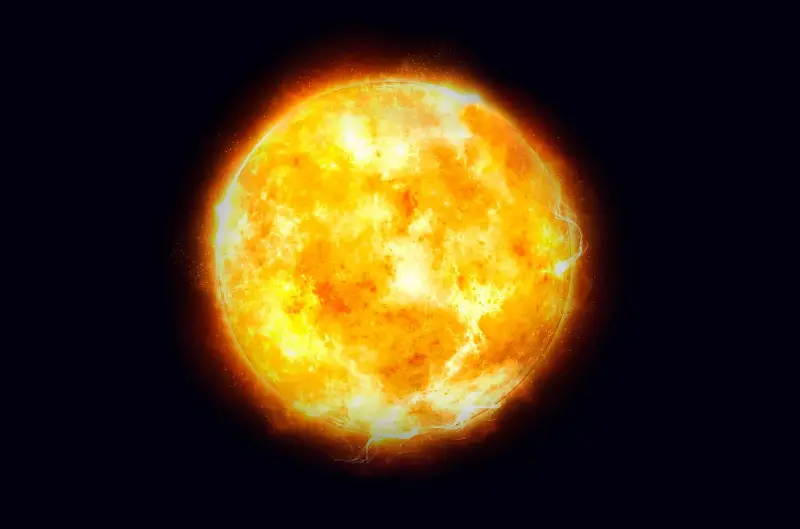
A giant planet somehow survived the violent end to its sun, and it may change what we predict for our own solar system’s fate.
The Earth’s sun will eventually die. This is a scientific fact: all stars eventually run out of fuel, and in our sun’s case, it is expected to approach its red giant phase a few billion years from now, expanding and swallowing nearby planets.
In the red giant phase, the dying star expands outwards, melting, evaporating and destroying inner rocky planets—with some experts believing the sun will swallow Mercury and Venus, according to NASA.
What exactly will happen to Earth and our solar system when the sun reaches this phase has been long studied and debated—and now, astronomers have discovered that one giant planet somehow survived the death of its own sun.
Study leader Ryan J. MacDonald of the University of St Andrews told Newsweek: “The surviving planets around the sun will initially move further away when the sun dies, due to the leftover white dwarf having less mass than the sun.
“However, the giant planet we have studied, WD 1856b, has moved in closer to the white dwarf. Our study finds that this inwards migration happened billions of years after the death of the star, and was most likely caused by the gravitational influence of two nearby red dwarf stars.”
In 2020, astronomers discovered a giant planet orbiting a dead star, known as a white dwarf, and wondered how it had survived the sun’s violent end of the red giant phase.
The new study, using NASA’s James Webb Space Telescope, saw international scientists analyze the planet’s atmosphere and reconstruct its journey.
Observations by the JWST also revealed methane and high-altitude hazes, or aerosols, in the planet’s atmosphere. The findings mark the first time astronomers have successfully characterized the atmosphere of a planet transiting a dead star, providing an unprecedented glimpse into the composition of a world orbiting a white dwarf.
Researchers said the detection demonstrates that even planets around stellar remnants can retain measurable atmospheres, opening a new avenue for studying the evolution and potential habitability of planetary systems after their host stars have reached the end of their lives.
It found that the planet originally orbited the star from a safe distance, and only migrated towards it billions of years after the star died.
“Our findings have bearing on the long-term fate of our solar system,” study co-author Christopher O’Connor of Northwestern’s Center for Interdisciplinary Exploration and Research in Astrophysics said in a statement in EurekAlert!
“In roughly five billion years, our sun will die, and we don’t know precisely what will happen to the planets at that time. The fact that planets can survive into that final stage of the stellar life cycle really widens the range of possibilities for where and when habitable planets might exist in the universe,” he said.
The planet—known as WD1856b and located around 80 light-years from Earth—is a gas giant with the same radius as Jupiter, and orbits a star about the size of Earth. When sunlike stars collapse, they become white dwarfs, which are the dense remnants left behind.
O’Connor called it “one of the most bizarre planetary systems we know of,” as the planet’s radius is around eight times bigger than the white dwarf, and it orbits so close that it completes a full revolution every 1.4 days.
The planet should not have survived the star’s red giant phase—which sees a sunlike star balloon to more than 100 times its original size.
O’Connor said there are two theories as to how the planet ended up where it is: That it had been swallowed by the star as it was dying and managed to survive on the other side, or that the planet migrated towards it due to the gravitational effect of other objects.
“The white dwarf is part of a triple star system, and the outer companion stars could have influenced WD1856b’s orbit,” he suggested.
The team investigated these theories using the NASA telescope and found that the planet was significantly hotter than expected, even accounting for the light from the close-by white dwarf. They found that it was likely that the planet heated up as it moved towards the star, and did so up to 5.5 billion years after it had become a white dwarf—meaning it had been at a safe distance during the star’s destructive phase.
“Our results suggest that the giant planets in our solar system could potentially, with sufficient time, move in their orbits closer to the white dwarf left behind when our sun dies,” MacDonald told Newsweek.
“This migration could be kick-started by mutual gravitational interactions between the giant planets, or potentially a flyby of another star to our solar system in the distant future.”
MacDonald said in a press release statement that this planet and star could offer a preview of what could happen when our own sun eventually dies, as it is “the first time we have been able to look forward to what might happen to the outer planets around the remnant of a sunlike star.”
“It’s like using a time machine to peer into the distant future of our solar system,” he said.
“Our results show that stellar death is not the end—some planets experience a vibrant and lively future after the death of their star.”
Reference
MacDonald, R.J., O’Connor, C.E., Boehm, V.A. et al. Aerosols and hydrocarbons in the atmosphere of a white dwarf planet. Nature 655, 76–80 (2026). https://doi.org/10.1038/s41586-026-10514-7