



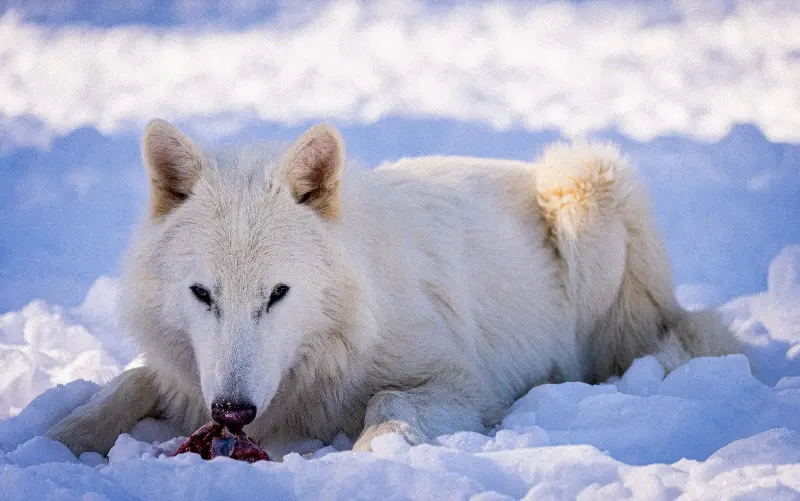
“Game of Thrones” dire wolf pups, which were brought back from extinction, are healthy and ready to breed, the biotech company behind the breakthrough has said.
Last year, Colossal Biosciences announced that it had used DNA from thousands of years ago to alter the genome of modern wolves and resurrect the lost species.
Dire wolves became extinct towards the end of the last ice age, about 12,000 years ago. They became well-known among Game of Thrones fans after George RR Martin, the author, included them in his best-selling fantasy novels.
Colossal Biosciences, which is based in Dallas, Texas, said its three pups – named Romulus and Remus after the founders of Rome, and Khaleesi, in honour of Martin’s dragon-riding heroine – had continued to thrive and were at breeding age.
It said it planned to create more wolf pups this year to expand the gene pool of the group and eventually allow it to begin breeding naturally.
Matt James, the company’s chief animal officer, said: “The plan is to create an inter-breedable population of dire wolves in which they would eventually breed naturally to create a sustainable population of the world’s first de-extincted species.
“We will grow the population through assisted reproduction initially and then eventually only rely on natural breeding.
“The dire wolf pack is actually breeding-aged at this point, but we will initially grow the pack through assisted reproduction while we create new, genetically diverse individuals to grow our pack.”
To create the species, scientists looked at the dire wolf’s closest living relative – the grey wolf – and compared its DNA with that of dire wolves to see where the sequences differed. They had collected samples of dire wolf DNA from a 72,000-year-old skull in Idaho and a 13,000-year-old tooth in Ohio.
Once they had discovered the differences between the species, scientists made 20 gene edits to the grey wolf genome to insert traits for a white coat, larger teeth, a more muscular build and a distinctive howl.
The altered cells were inserted into egg cells from domestic dogs and implanted into the wombs of surrogate dogs. The wolves were born by caesarean section to minimise the risk of complications.
Ben Lamm, the chief executive and co-founder of Colossal Biosciences said: “The dire wolves are doing great. The three dire wolves live on a 2,000-acre secure, expansive ecological preserve that allows us to monitor and manage them while providing them a semi-wild habitat to thrive in.
“We hope to have more dire wolf pups by the end of the year.”
Colossal Biosciences’ wolves live in an undisclosed location in the northern US, where they are fed beef, deer, horse meat and a specially formulated dried pet food.
Dire wolves roamed the plains of what are now North and South America during the Pleistocene Epoch (from 2.58 million to about 11,700 years ago). They are believed to have died out as the climate warmed and prey animals declined.
The biotech company has said it wants to resurrect the dodo, which it intends to rewild on Mauritius, the original home of the flightless bird that was hunted to extinction in the 17th century.
It is also planning to bring back the woolly mammoth and has practised inserting mammoth traits into small mammals, creating the first “woolly mice” last year.
Other creatures on Colossal Biosciences’s list for “de-extinction” include the thylacine or Tasmanian tiger, which became extinct in 1936, and the moa, a 12ft-tall bird that once dominated the forests of New Zealand but went extinct between the 13th and 15th centuries.
Last month, it announced it was planning to resurrect the Bluebuck, a rare blue antelope that was hunted to extinction in southern Africa within 40 years of being scientifically described.
Several scientists have criticised Colossal Biosciences, saying the animals are not really an extinct species, but rather genetically altered hybrids of animals that are still alive.
The company has admitted that its work will not produce a “100 per cent identical” extinct creature.