



Remember the much-loved Ford Fiesta? Car manufacturers say that emissions directives and crash-test requirements, not to mention our taste for luxury trimmings, mean it’s no longer profitable to produce small cars. Yet Renault-owned Romanian brand Dacia has proved with its great-value Sandero (from £14,765) that a significant proportion of people still prefer an unpretentious compact hatchback to a large and luxurious SUV.
In 2024, the Sandero overtook the Tesla Model Y to become the best-selling car in Europe, retaining that title last year. The profit margins may be slim, but with clever cost-cutting, there’s still money to be made at the budget end of the market.
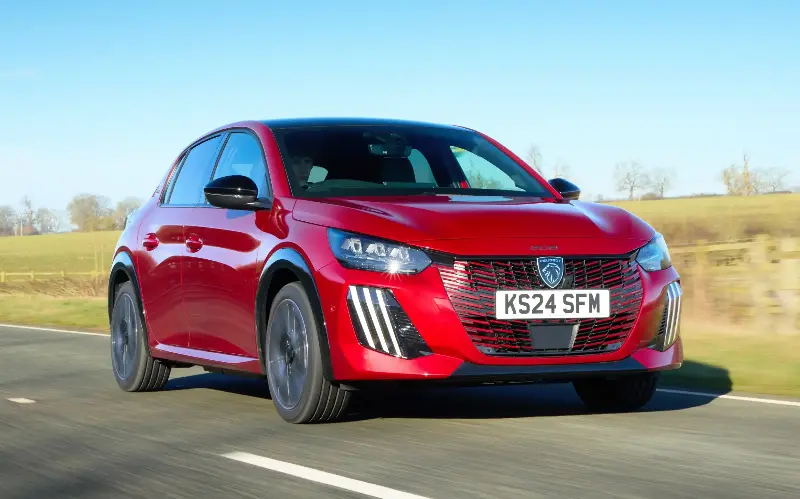
Among those looking enviously at Dacia is Peugeot. Its attempt to grab a slice of sales is this entry-level 208. Called the Style 100, the Peugeot is priced below £20,000 – almost £2,000 cheaper than the Active 100 it replaces.
Pros
- Stylish looks, inside and out
- Decent, fun to drive at urban speeds
- Zippy engine
Cons
- Engine drone on motorways
- Cramped rear seats
- Not as cheap as it needs to be
Style counsel
The specifications are identical but for the Style, some interior trim has been subtly downgraded. But it still has air-conditioning, cruise control, automatic headlights and wipers, rear parking sensors and much more besides. Pretty good for a base model, until you realise that the entry-level Renault Clio provides all these and more for almost £2,000 less. As does the top-spec Dacia Sandero.
Externally, the only visual differences between this and the top-of-the-range GT Premium are steel wheels with nicely designed trims and black (rather than body-coloured) grille slats.
Inside, meanwhile, the 208’s sweeping, scalloped interior design has always been one of its strongest points, so the Style doesn’t feel downmarket.
There’s no electronic handbrake, though that’s not necessarily a bad thing, as many people still prefer a traditional lever. The same goes for the analogue main instruments fitted instead of a digital display. This base model also has the odd but tactile carbon-fibre-effect dashboard trim and glossy, chrome-rimmed piano key switches of posher 208s.
Blowing hot and cold
There’s also a wide touchscreen and a well-damped rotary knob for the volume, but sadly, you have to use the touchscreen to alter the climate settings. This is more of a problem in the Style than in the rest of the range, because the manual air-conditioning requires you to adjust the temperature more frequently than “set and forget” climate control. You frequently have to exit the function you were using to select the climate-control menu, then adjust the temperature with a tricky on-screen slider. That means your attention is drawn from the road each time you feel it’s a little too warm or too cool.
Space in the back isn’t great, either. Buy a Skoda Fabia – or, yes, a Sandero – if you need to use the rear seats on a regular basis.
The boot is a decent size, however, at 352 litres – not as large as the class-leading Renault Clio’s, but perfectly respectable. There’s lots of room for your odds and ends inside, too.
The three-cylinder, 1.2-litre engine has a patchy reputation as a result of its troublesome “wet” timing belt design, but all examples built since March 2026 have a metal timing chain instead. The Style 100 badge is a bit misleading, though: this engine delivers 89bhp rather than 100PS (98.6bhp).
It’s quite noisy and in the 208 it isn’t brilliantly damped – you can both hear it and feel the vibration through the steering wheel and pedals. And while there’s a spike of torque midway up the rev range, it soon dies away so you have to make copious use of the rather stodgy gearbox to get the best from it.
Peaky blinder
The engine’s zingy character can be quite good fun, although the peaky power delivery and raucous engine note can grow wearisome while slogging through a tailback on the M25 on a wet Tuesday evening. The not-inconsiderable wind and road noise might become tiresome on long motorway journeys, although the presence of a sixth gear helps reduce the engine note to a more tolerable level once you’re up to speed.
The driving position isn’t the most comfortable for long distances, either. You always feel as though you’re leaning forward over the top of the small steering wheel, rather than hunkered down behind it.
However, the 208 was designed for urban environments, where it feels suitably nimble and nippy, its front end responding well when jinking into gaps or negotiating roundabouts.
It damps out bumps reasonably well, too. There are more comfortable small cars, but equally some feel far firmer. As it is, the 208 provides a satisfactory blend between bump absorption and handling ability.
The Telegraph verdict
The 208 is perfectly decent for the price – it’s just that its rivals are priced more keenly. The Renault Clio, for example, is just as smart and costs almost £2,000 less. Its air-conditioning is easier to adjust, too, while the boot is larger. That’s before considering the Dacia Sandero or the Suzuki Swift.
That leaves the 208 Style as a good cheap-car effort, but one that still manages to look a little overpriced. But it’s definitely worth a test drive if you can get a good deal on finance because it’s likeable, looks good, goes well, is affordable to run and is even pleasurable to drive.
The best news of all is that manufacturers are again turning their attention to affordable small cars. The 208 Style might not be the one I’d choose, but I’ll celebrate its existence all the same.
The facts
On test: Peugeot 208 Style 100
Body style: five-door hatchback
On sale: now
How much? £19,745 on the road (range from £19,745)
How fast? 117mph, 0-62mph in 10.1sec
How economical? 54.3mpg (WLTP Combined)
Engine & gearbox: 1,199cc three-cylinder petrol or diesel engine, six-speed manual gearbox, front-wheel drive
Maximum power/torque: 89bhp/151lb ft
CO2 emissions: 118g/km (WLTP Combined)
VED: £455 first year, then £200
Warranty: 3 years/60,000 miles (no mileage cap in first two years)
Spare wheel as standard: no (optional extra)
The rivals
Renault Clio TCe 90 Generation
89bhp, 54.3mpg, £17,995 on the road
Roomier, better equipped, cheaper and just as powerful as the Peugeot (despite it being badged as 100PS). The one to go for if you can’t stomach a Dacia.
Seat Ibiza 1.0 TSI 95 SE
94bhp, 55.9mpg, £20,995 on the road
Slicker and more refined to drive than the 208. It’s also roomier in the back seats, although if that’s important it will cost more than £1,000 extra.