



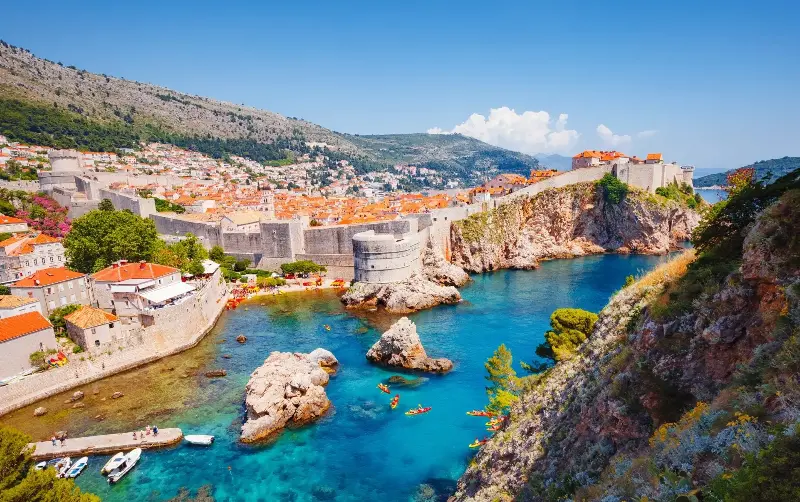
Overlooking the calm blue Adriatic, Dubrovnik is one of the world’s most magnificent walled cities. Once the capital of the mighty sea-faring Republic of Ragusa (1358-1808), it’s now Croatia’s most upmarket destination. Historically, this diminutive republic was sophisticated, refined and cultured.
Today, the pedestrian-only Old Town – packed with aristocratic palazzi and elegant Baroque churches, contained within sturdy medieval fortifications – draws hundreds of thousands of visitors annually. The city has seen recently visits from glamorous names including Nicole Kidman, Leonardo di Caprio, and Jeff Bezos and Lauren Sánchez, who honeymooned here aboard their superyacht. Beyond the walls, attractions include wine bars, classy seafood restaurants and five-star hotels.
And then there’s the glorious rock-and-pebble coast, with beaches, scuba diving and sea kayaking. Some of the best beaches lie on Lapad peninsula, two miles (3km) west of town; or you might try tiny Lokrum islet, with its botanical garden; or the pine-scented Elaphiti islands. I’m particularly looking forward to the August 2026 reopening of two historic hotels, the Villa Argentina Dubrovnik and Villa Orsula, following renovation.
No matter what your reason for visiting is, you’ll find plenty to explore. Here’s how to fill a weekend in the city.
In this guide:
How to spend your weekend
Day one: morning
Any first-time visit to Dubrovnik should begin with the full circuit (just over a mile) of the magnificent 13th-century City Walls. It will take well over an hour, and you can expect ever-changing perspectives over the terracotta rooftops of the Old Town and out to sea.
Afterwards, stroll along the limestone-paved Stradun (aka Placa), the main pedestrian thoroughfare through the Old Town, running from Pile Gate in the west to Ploče Gate in the east. Originally a sea channel, it was filled in during the 12th century, and is now lined with baroque stone buildings hosting souvenir shops and pricey cafés at ground level.
On Gundulićeva Poljana (Gundulić Square), take a look at the open-air morning market. In the past, all the stalls sold local seasonal fruit and vegetables, but nowadays you will see mainly traditional gifts aimed at tourists – pretty handmade lavender bags, lavender oil, arancini (candied orange peel), bruštulane mjendorle (sugar-coated almonds), and dried figs. For lunch, grab a sandwich at Buffet Škola in a narrow alley off Stradun – the chefs bake fresh bread and fill slabs of it with local cheese and pršut (similar to prosciutto), and also do a yummy homemade apple strudel.
Afternoon
To get some idea of how local aristocrats once lived, visit the Cultural History Museum. Based in the 15th-century Rector’s Palace, this is where the rector (city governor) would reside during his one-month term in office. On display are portraits of cross-looking local nobles, as well as period furniture, costumes and clocks. It was also used as a filming location for Game of Thrones – if you’re a fan, you will recognise it as the atrium to the Spice King’s palace in Qarth.
Nearby, the 17th-century Baroque Cathedral is also well worth a look in for its impressive Treasury, displaying ornately crafted golden reliquaries, including the skull of St Blaise, Dubrovnik’s patron saint. And just five minutes away, at the Male Braće pharmacy just inside the Franciscan Monastery, you can purchase luscious rose face cream to take home, made to a secret medieval recipe concocted by the monks.
Late
Spend the evening in the Old Town, packed with candlelit tables and sun-tanned diners on summer evenings. Start with a sunset drink at Buža, accessed through a tiny doorway in the city walls. Tables are arranged on a series of levels on the rocks overlooking the sea – informal but truly magical on a balmy evening.
Then, splash out at the romantic fish restaurant Proto, to feast on lobster risotto and grilled sea bream – King Edward VIII and Wallace Simpson dined here in 1936. Round off the evening with a nightcap at my favourite wine bar, M’arden, serving quality Croatian wines in a secluded walled garden.
Day two: morning
Start the day with a visit to 13th-century Fort Lovrijenac. Lying outside the Old Town, it affords superb views of the City Walls, making it a favourite photo spot. Climb up 175 steps to reach the upper level, complete with cannons and a small chapel.
Then return to town to shop for gifts. Immediately outside Ploče Gate, Life According to Kawa is a welcoming concept store, specialising in quirky Croatian designer items, including their own limited edition of Dalmatia-inspired T-shirts and mugs, tastefully packaged rakija (a potent local spirit) by Mashtel from Nin, and beautifully illustrated Croatian cookery books.
Nearby, inside Ploče Gate, Dubrovačka Kuća stocks paintings and ceramics by recognised Croatian artists, including raku-glazed ceramic fish by Ljiljana Barbarić, and ceramic candle-holders decorated with floral motifs by Andrea Bassi. Have lunch at Barba, serving street food based on fresh local seafood – try the octopus burger.
Afternoon
To discover more about Dubrovnik’s historic naval power, visit the Maritime Museum in St John’s Fortress, overlooking the old harbour. In the 16th century, the city-republic had one of the world’s largest fleets, with more than 180 ships and 4,000 sailors – exhibits here include model ships from that time, as well as navigational equipment, flags and maps.
Afterwards, grab an ice cream at nearby Gianni’s, then spend the afternoon sunbathing and swimming in the deep blue Adriatic. Banje beach, immediately outside the town walls, and has a bar serving chilled drinks – take your own beach towel and lie on the pebbles, or pay extra for a sun-bed and parasol. Above the beach, there is a lounge and bar on a wooden deck, serving cocktails and snacks.
Late
Start the evening with a ride up to Mt Srđ aboard the Dubrovnik cable-car. From up on high you get superb sunset views down onto the city walls, the sea and islands. There’s also a bar and restaurant if you feel like splashing out on an aperitif before returning to town.
For dinner, head to Azur, a personal favourite, serving unusual but astoundingly delicious “Cro-Asian” dishes devised by the owner-chef, combining Dalmatian ingredients with Thai spices and fragrant herbs – I recommend the superb swordfish green curry. Close the day at Fratello’s Prosecco Bar, a 10-minute walk west of Pile Gate, sipping Croatian sparkling wine on its glorious sea-view terrace.
When to go
For most people, the best months to come here are May to June or September to October. Expect sunny days with the sea warm enough to swim, and hotels, restaurants and tourist attractions open, but with fewer crowds – though it will still be busy. Flights are generally reasonably priced.
During peak season, July to August, Dubrovnik is overrun by tourists – hotel and flight prices rocket, restaurants and beaches are packed, and there are queues at all the main attractions, but on the plus side you get the Dubrovnik Summer Festival and glitzy nightlife.
Low season, November to April, can be lovely, though most facilities are closed, flights are less frequent and the weather is less reliable. One downside of the increase in tourism is that many locals have sold up and moved to the Lapad suburb, so the Old Town can feel semi-abandoned come winter.
Some hotels and restaurants now open for Christmas and New Year, but almost everything is shut through the rest of January. And while a few places reopen for St Blaise’s Day (February 3) and Carnival, the new season only really begins at Easter.
Where to stay
Luxury living
Villa Dubrovnik stands high above the sea, a 15-minute walk along the coast east of the Old Town. It reopened in summer 2025 following renovation, to reveal stunning contemporary interiors by Brazilian architect Arthur Casas. Out front, a series of terraces lead down to a rock-and-stone beach front with secluded sunbeds and parasols. It offers gourmet dining and a spa, and was awarded a Michelin key in autumn 2025.
Designer digs
Villa Orsula is a romantic boutique retreat set in a 1930s white stone villa, much loved by travellers for its discreet luxury, impeccable service, and sublime sea views towards Dubrovnik’s old town walls. There are just 13 elegant rooms, a chic restaurant with tables on a vine-draped terrace, and a secret beach.
Budget beauty
My absolutely favourite place to stay in Dubrovnik’s Old Town is a welcoming, family-run boutique hideaway in a historic stone building. Van Bloemen Apartments have bohemian décor with an eclectic mix of antiques, quirky bric-a-brac, floral fabrics and modern art. A 10-minute walk up the Stradun brings you to Pile Gate, the main entrance into the Old Town.
Know before you go
Essential information
- British Consulate: The British Honorary Consulate Dubrovnik is closed until further notice. If you need consular assistance in the area, you are advised to call the British Embassy Zagreb (Ivana Lučića 4, Zagreb; 00 385 1 600 9100; gov.uk)
- Croatian Emergency services: Dial 112
- Dubrovnik Tourist Office: Brsalje 5 (just outside the old town, close to Pile Gate); 00 385 20 312011; tzdubrovnik.hr. Open daily 8am-8pm (May-Oct), Sun 10am-4pm. There is also a smaller tourist information office at Obala Ivana Pavla II, br. 1, Gruž (close to the ferry port); 00 385 20 417983. Open daily 8am-8pm (May-Oct).
Basics
- Currency: Croatia joined the Euro (€) on Jan 1, 2023
- Telephone code: 00 385
- Time difference: +1
- Flight time: London to Dubrovnik is around two hours and 40 minutes