



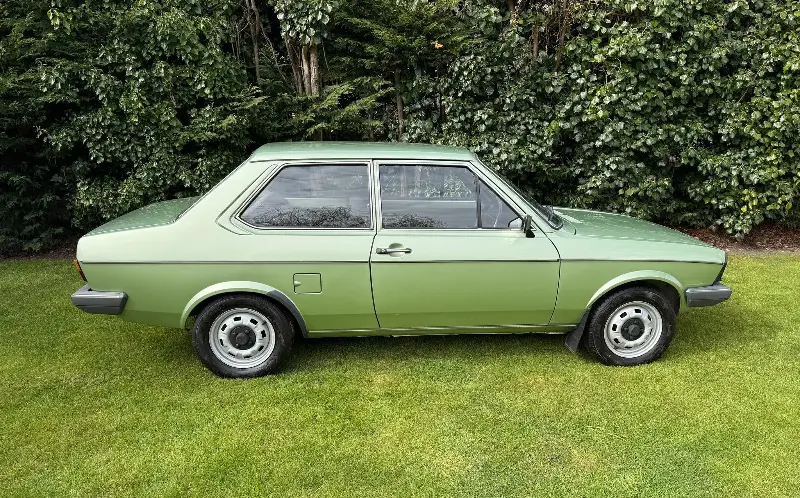
At the start of the 1980s, the sight of a metallic green Volkswagen Derby GLS seldom elicited a strong reaction, which was precisely as its owners preferred it. This was a car for those who valued understatement over vulgar stripes and spoilers, along with a “proper” boot instead of a newfangled hatchback.
The Derby is the saloon version of the Volkswagen Polo Mk1: the two are identical from the central pillar forward. After market research suggested that at least 40 per cent of German motorists preferred a traditional “three-box” saloon with a separate boot to a hatchback, Volkswagen created the Derby. It debuted in February 1977 at the Amsterdam motor show, 23 months after the Polo.
The Derby was 14in longer than its parent model, and one sales point was a boot capable of carrying 18.2 cubic ft (515 litres) of luggage – more than the much larger Ford Cortina Mk4. Domestic customers had a choice of 895cc, 1,093cc and 1,272cc engines; the home market Derby initially proved so popular that within 11 months Volkswagen had built 112,783 examples and it outsold the Polo.
The Sunday Telegraph reported from Amsterdam that the UK concessionaires were uncertain about selling the Derby in this country. However, cars with a separate boot were still popular with British motorists. The Cortina, Ford Escort Mk2, Morris Marina, Mini and Austin Allegro – all with separate boots – were the five best-selling models of 1977. By then, the sole Volkswagen car sold in the UK without a tailgate was the Beetle, which seemed a world apart from the Polo, Golf, Scirocco and Passat.
Imports eventually began in 1978, with Volkswagen offering only the 1.1-litre model at first, shortly followed by the 1.3-litre GLS. The Telegraph’s Motoring Correspondent wrote that his test of the Polo began with “Is this the best small car yet?” and that two years later he found himself asking the same question about the Derby. Motor hailed it (and the Polo) as “one of our favourite small cars”.
Volkswagen promoted the Derby as ideal for buyers who craved durability, suggesting that it would “last donkey’s years”. One Derby advertisement featured a picture of the Beetle, UK imports of which ended in 1978, to convey the message that the Derby would have similar lasting power.
Home market sales of the Derby declined after its first spate of popularity and Volkswagen gave it a facelift it in 1979 with rectangular headlights to further differentiate it from the Polo. With the GLS, Volkswagen promised buyers a car capable of 0-60 in 12.9sec, out-accelerating the Fiat 131 Mirafiori 1300 L and the 1.3-litre Austin Allegro.
The Derby Mk2 replaced the original version in October 1981, after 303,900 units. As for the surviving numbers, 15 examples of the GLS Mk1 are believed to remain on the road. Today, this is a prime example of the top-of-the-range Derby: a car “distinguished by polished hub caps”, as Volkswagen described it to potential buyers.
It has been spared customisation and looks appropriate for the young professional with an eye to an Audi 80 B2 as their next vehicle. From a 2026 perspective, the GLS’s cabin is a fascinating blend of practicality and chintz, with the dashboard’s fake woodwork an especially pleasing touch.
And if those hubcaps did not bestow sufficient kudos on the owner, the GLS also featured velour upholstery, front head restraints, a digital clock and a choice of metallic paint finishes. Volkswagen boasted of its trip mileage recorder, vanity mirror in the front passenger’s sun visor, cigar lighter and “illuminated instrumentation”. Expectations of “luxury travel” could be quite modest in 1981.
The price of such decadence was £4,149 and, as a small, two-door, front-wheel-drive saloon, the Derby had few direct rivals. The Austin Allegro 1.3 HL was £4,169 but lacked the Volkswagen’s three-box styling, while the Vauxhall Chevette L saloon for £3,869 was rear-wheel-drive. At £2,990, the Fiat 128 1300 CL was cheap and offered an extra pair of doors, but its lines dated back to 1969.
But no competitor could offer the Derby GLS’s blend of “a classical shape with modern concept”. Not to mention: “Its elegant styling impresses.”
Thanks to Mark King.
We use the fascinating howmanyleft.co.uk for figures of surviving examples, but some cars present more of a challenge than others, so the figures are rarely authoritative. Some pre-1974 records were lost before the DVLA centralised the process, while some cars have their model type misnamed on the V5 registration documents. A further issue is the omission of the exact model name or generation, or distinction between saloon and estate bodystyles.