




Weather forecasting is another aspect of modern life that artificial intelligence is transforming. Models like GraphCast, Pangu-Weather, and Fuxi are already better than traditional physics-based climate models at predicting some daily weather conditions. However, they are far from perfect. A new study published in the journal Science Advances reports that AI often fails to predict record-breaking extreme weather events.
Thanks to our changing climate, extremes such as record heat waves and windstorms are becoming more frequent. Accurate warnings are vital to help protect lives, property, and infrastructure. However, the unprecedented nature of these events poses a problem for AI.
To understand why, scientists pitted leading AI models against HRES (High Resolution Forecast), considered one of the world's leading physics-based weather prediction systems. They first built a large database of record-breaking heat, cold, and wind events from 2018 and 2020. The researchers then checked the forecasts that HRES and the AI models had already made for those years to see which system got closest to the real-world outcomes.
AI underestimating the risk
For everyday weather forecasting, AI models were often more accurate and much faster than HRES. But in record-breaking events, HRES clearly outperformed artificial intelligence across all types. For example, during record-breaking heat waves, the AI models consistently predicted temperatures much lower than those observed. Not only that, the more a record was broken, the less accurate the AI became.
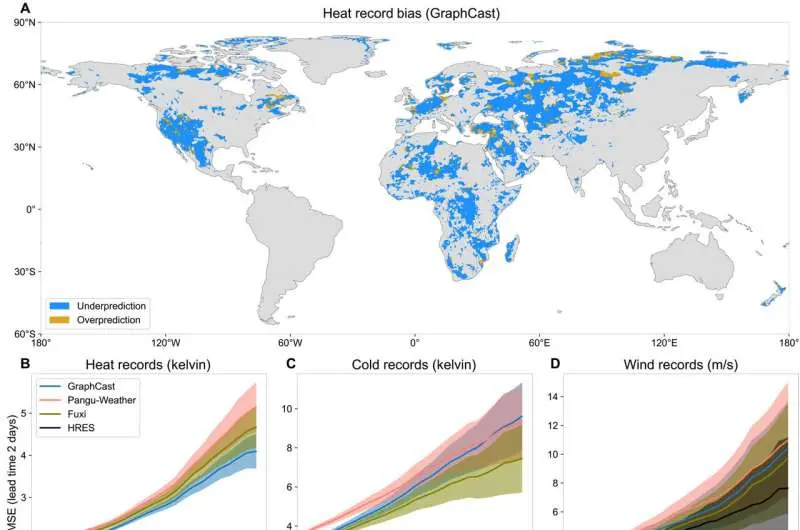
According to the scientists, the superiority of HRES in these high-stakes situations comes down to its reliance on the laws of physics. Because they never change, physics-based models can better simulate scenarios the world has never seen before. The AI models were dealing with events outside their training data and were trying to pull their forecasts back toward more typical historical averages.
"Our findings underscore the current limitations of AI weather models in extrapolating beyond their training domain and in forecasting the potentially most impactful record-breaking weather events," commented the research team in their paper.
A hybrid approach for the future
Given the expectation that extreme events will become more frequent in the coming years, the researchers caution against relying solely on AI for such important work. Instead, they suggest a hybrid approach that combines the speed of AI with the strong foundation of the fundamental laws of physics.
"Further rigorous verification and model development is needed before these models can be solely relied upon for high-stakes applications such as early warning systems and disaster management."
Written for you by our author Paul Arnold, edited by Lisa Lock, and fact-checked and reviewed by Robert Egan—this article is the result of careful human work. We rely on readers like you to keep independent science journalism alive. If this reporting matters to you, please consider a donation (especially monthly). You'll get an ad-free account as a thank-you.
Publication details
Zhongwei Zhang et al, Physics-based models outperform AI weather forecasts of record-breaking extremes, Science Advances (2026). DOI: 10.1126/sciadv.aec1433
© 2026 Science X Network
Citation: Physics-based weather models more accurate than AI at predicting extreme weather (2026, May 5) retrieved 5 May 2026 from https://phys.org/news/2026-05-physics-based-weather-accurate-ai.html
This document is subject to copyright. Apart from any fair dealing for the purpose of private study or research, no part may be reproduced without the written permission. The content is provided for information purposes only.