



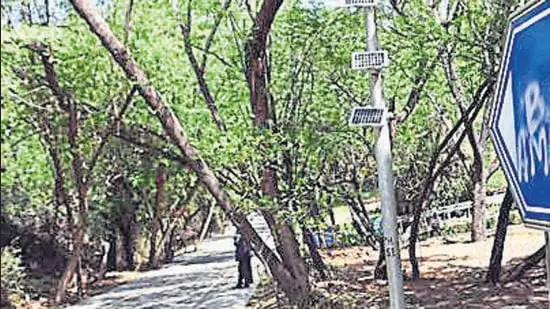
A new study on roadside green spaces, conducted within the Jawaharlal Nehru University campus, has found that while trees help reduce air temperature by up to 2.24°C and land surface temperature by 3.80°C to 8.37°C, the carbon storage capacity of invasive trees such as subabul and vilayati kikar is far lower than that of native trees.
The study said invasive species are not only ecologically harmful but also deliver substantially lower long-term ecological benefits, and advocated the plantation of native varieties along roads.
The study, titled “Roadside green spaces: role of tree diversity in carbon storage and thermal comfort”, was conducted in April and May 2025 and published in December 2025 in the urban science journal “Discover Cities”.
It was conducted across 59 plots (10m × 5m each) covering a 5.5km stretch along four roads inside the JNU campus — the Main Gate, East Gate/Vice-Chancellor Gate, Stadium Road and Ring Road.
These stretches supported 27 tree species from 27 genera and 15 families, comprising 19 native, six introduced and two invasive species.
Among the 19 native tree species studied, chamror (Ehretia laevis) stored the highest amount of carbon at 6.20 tC/m2, followed by karanj (Pongamia pinnata) at 4.37 tC/m2 and amaltas (Cassia fistula) at 3.66 tC/m2. In comparison, the invasive species vilayati kikar (Prosopis juliflora) and subabul (Leucaena leucocephala) stored only 0.23 tC/m2 and 0.59 tC/m2, respectively.
“The diversity was moderate, with an overall 47.17% invasion by subabul and vilayati kikar. Despite the high abundance of invasive species, their contribution to carbon stock was minimal (total estimated at 0.312 tC/m2) compared to native species,” the study said.
“The roadside green spaces significantly enhanced urban thermal comfort, as evidenced by air temperature reductions ranging from 0.80°C to 2.24°C and land surface temperature reductions ranging from 3.80°C to 8.37°C,” the study highlighted.
Professor Usha Mina, from the School of Environmental Sciences, JNU, who was part of the study, said it highlighted several key aspects.
“Between April and May 2025, and between 12pm and 3pm when temperatures are highest, roadside green spaces were found to provide considerable cooling, both in terms of air and land surface temperature. In terms of carbon sequestration, while all trees capture carbon, we found native species performed better than invasive trees. The study highlights the need to maintain good species diversity along roads, which will not only make roads cooler and capture carbon dioxide, but also help reduce air pollutant load. Species selected should be more efficient in mitigating air pollution, with greater leaf density and lower volatile organic compound (VOC) emissions,” she said.
She added that cooling is not simply a function of tree density, but also depends on structural traits such as whether species are evergreen or deciduous, crown spread, leaf texture, vertical stratification and spacing relative to built surfaces. “Tall, narrow crowns or poorly layered canopies can trap heat and restrict ventilation despite high stem density. In contrast, species with broad crowns and staggered spatial arrangements can improve convective cooling and surface shading even at lower densities,” she said.
She further said evergreen species are recommended because of their superior particulate matter absorption and reduction capabilities.
“Year-long CO2 removal from the atmosphere and the presence of leaves that trap roadside dust, especially where vehicular emissions increase the pollutant load in the ambient air, make evergreen roadside tree species more beneficial than deciduous trees,” she added.
“To fully realise the potential of roadside green spaces, invasive species management should be integrated into routine urban green space policy, followed by post-intervention ecological monitoring to track the recovery of native species and improvements in ecosystem service delivery,” the study noted.
Manjul Panwar, a PhD research scholar at JNU’s School of Environmental Sciences and co-author of the study, said invasive species should ideally constitute only a minimal share of plantations.
“We conducted the study within JNU, where flora and fauna receive relatively greater protection compared to surrounding urban landscapes of Delhi. Across the four stretches we studied, subabul and vilayati kikar dominated the vegetation, accounting for nearly 50% of the total green cover. The remaining were native species such as amaltas, bael, karanj and arjun,” Panwar said.
“The predominance of invasive species can be attributed to their higher adaptability to Delhi’s soil conditions and low groundwater availability, making them easier to cultivate and maintain. However, despite their resilience, these species provide comparatively lower ecological benefits. Native species store more carbon over the long term, while invasive species have lower carbon storage capacity. Given Delhi’s heat stress, plantation of native species will have a far greater impact on cooling temperatures than the green look and feel created by invasive trees,” he added.